.png)
The Hidden Cost of Delayed Decisions in Industrial Projects
In industrial projects, delays are often blamed on suppliers, contractors, or regulators. However, one of the most overlooked causes of project failure is slow decision-making by project stakeholders.

1. Why Delayed Decisions Are So Destructive
In the high-stakes environment of industrial project management, time is the ultimate currency. When capital project execution falls behind, the immediate instinct of most project sponsors is to blame external factors: global supply chain disruptions, regulatory hurdles, or underperforming contractors. While these factors certainly contribute to schedule risk, they frequently mask a much more pervasive and controllable root cause: the internal inability to make timely decisions.
A slow approval process is the silent killer of capital projects. Whether it involves hesitating on a critical design variation, deferring a major equipment purchase to "gather more data," or waiting weeks for a steering committee to convene, postponed choices generate a cascading effect across the entire project lifecycle. Every day an engineering team waits for a client's sign-off is a day the construction schedule slips, exposing the project to immense financial liabilities.
Why It Matters: The Compounding Costs of IndecisionFor many industrial projects, the cost of indecision is far greater than the cost of making a well-informed decision quickly. Every day of delay can generate:
Increased project management costs: Extended timelines mean paying for project leadership, engineering teams, and administrative overhead for longer than budgeted.
Extended contractor mobilization expenses: Keeping cranes, heavy equipment, and specialized labor on standby accrues massive daily holding costs.
Inflation impacts on materials and labor: In volatile markets, delaying procurement by even a few weeks can result in double-digit percentage increases in raw material prices.
Lost production revenue: Every month a manufacturing plant or refinery is delayed is a month of unrecoverable product sales and lost market share.
Delayed return on investment: Prolonged capital lock-up degrades the project's Net Present Value (NPV) and frustrates investors and lenders.
2. Slow Approvals and Late Reviews Create Hidden Schedule Risk
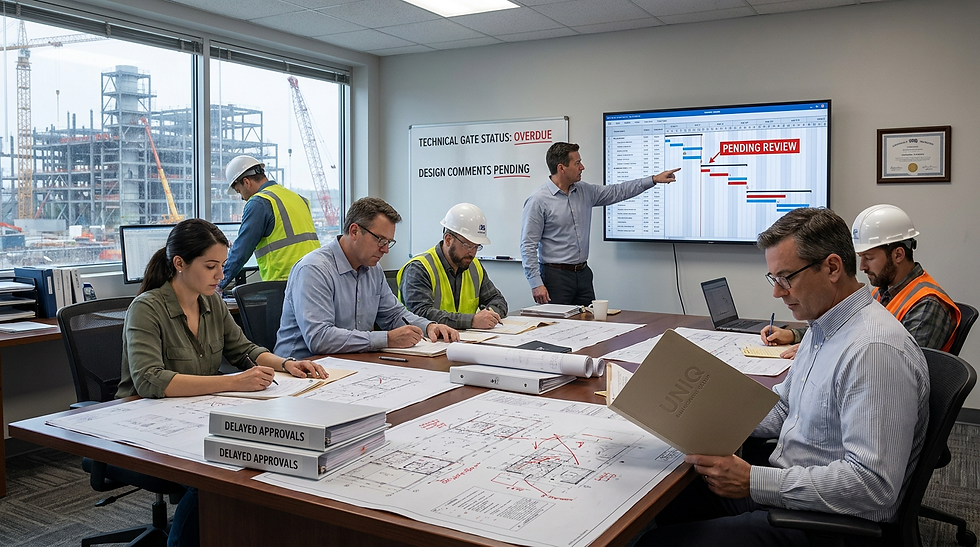
During the Front-End Loading (FEL) and detailed engineering phases, the pace of the project is entirely dependent on the flow of information. Industrial project schedule management relies on a sequential chain of events. When an owner's technical team takes four weeks to review a piping and instrumentation diagram (P&ID) instead of the contracted one week, the entire engineering baseline shifts.
This hesitation often stems from an organizational culture that penalizes making the "wrong" decision more than it penalizes making no decision at all. Reviewers frequently demand absolute certainty, requesting endless revisions and minor optimizations. However, this pursuit of engineering perfection introduces massive schedule risk. By the time the design is finally approved, the procurement window for long-lead items may have closed, pushing the commissioning date back by months.

3. Procurement Hesitation and Governance Confusion Amplify Cost
The cost of project delays in manufacturing becomes glaringly apparent during the procurement phase. Supply chains for critical industrial equipment—such as turbines, compressors, and specialized transformers—operate on strict production slots. If an executive steering committee delays signing a purchase order by just a few days, the project may lose its slot in the manufacturer's queue, resulting in a six-month delivery delay.
Furthermore, these delays are frequently the byproduct of unclear project governance. When an organization lacks a clearly defined delegation of authority (DOA), simple procurement choices escalate to the C-suite, languishing on the desks of executives who lack the technical context to approve them quickly. Stakeholder management breaks down when there are too many veto points and not enough empowered decision-makers.
"The most expensive decision on a capital project is the one that is never made. Waiting for perfect information virtually guarantees that you will run out of time and budget."

4. Real-World Patterns Behind Decision-Driven Project Delays
Understanding how delayed decisions affect industrial projects requires looking at the operational mechanics of the site. Consider the implications of change management during active construction. If a contractor encounters an unexpected clash between structural steel and electrical routing, they will issue a Request for Information (RFI).
If the owner's engineering team takes three weeks to adjudicate the RFI, the contractor must either demobilize their crew or reassign them to less critical tasks, destroying site productivity. These seemingly minor delays accumulate rapidly. A pattern of slow RFI responses invariably leads to aggressive contractor claims for extension of time (EOT) and acceleration costs, poisoning the commercial relationship and derailing the project controls baseline.

5. What Leaders Must Do to Improve Project Decision Making
Improving project decision making requires an intentional shift in organizational culture and structural governance. To mitigate the devastating impacts of indecision, project sponsors and executives must actively engineer a project environment built for speed and accountability.
Practical Governance and Decision-Making Actions:
Establish a clear Delegation of Authority (DOA): Push decision-making power as far down the organizational chart as technically feasible. Do not force routine engineering or procurement choices to the executive board.
Implement strict Service Level Agreements (SLAs) for approvals: Treat internal reviews just like external contractor milestones. Mandate that all RFIs, design reviews, and commercial approvals must be processed within a strict 5-to-7 day window.
Adopt a "Fit-for-Purpose" mindset: Train technical teams to avoid "gold-plating" designs. Decisions should be based on meeting the functional specification safely, not on endless, time-consuming optimization.
Create a dedicated change control board: Ensure that when project variations are required, a small, empowered group meets weekly to adjudicate changes rapidly, preventing site standstills.
Integrate schedule impact into every decision: Require that every pending approval highlights the daily burn-rate cost of delaying the decision, making the financial impact of hesitation highly visible to stakeholders.
6. Conclusion
Reducing delays in capital projects is not solely about optimizing contractor performance or deploying better scheduling software; it is fundamentally about project leadership. The pace of the project will never exceed the pace at which its leadership can process information, evaluate risk, and commit to a course of action.
For owners, sponsors, and industrial developers, recognizing that time is money must move from a boardroom cliché to an operational mandate. By streamlining governance, empowering project managers, and cultivating a culture that prizes decisive action over perfect information, organizations can eliminate the hidden costs of delay. Ultimately, making bold, timely decisions is the sharpest tool a leadership team possesses to safeguard their budgets and guarantee successful industrial project delivery.


Comments