.png)
Industrial Decarbonization: Turning Sustainability into Competitive Advantage
Decarbonization is no longer just an environmental objective. Learn how industrial companies can reduce emissions while improving efficiency, attracting investment, and enhancing competitiveness.
1. Why Industrial Decarbonization Has Become a Strategic Priority
For decades, the heavy industrial and manufacturing sectors viewed emissions management primarily through the lens of regulatory compliance—a necessary cost of doing business. Today, that paradigm has fundamentally shifted. Industrial decarbonization is now a critical commercial and strategic imperative. Driven by shifting consumer demands, stringent international climate policies, and evolving capital markets, the transition toward a net zero industry is actively reshaping global supply chains.
Companies that delay their climate transitions face compounding risks: rising carbon taxes, exclusion from premium green supply chains, and a significantly higher cost of capital. Conversely, early movers are discovering that embedding carbon reduction into their core business strategy acts as a powerful catalyst for operational excellence. It forces a rigorous re-evaluation of energy use, material waste, and process inefficiencies, ultimately leading to a leaner, more resilient enterprise.

2. Carbon Reduction Strategy Starts With Operational Reality
A viable carbon reduction strategy does not begin with purchasing carbon offsets or making vague corporate pledges; it begins on the shop floor. For asset-heavy businesses, the most immediate and profitable emission reductions come from aggressive energy efficiency initiatives. Many legacy manufacturing facilities operate with hidden inefficiencies—compressed air leaks, uninsulated steam lines, and continuously running legacy motors.
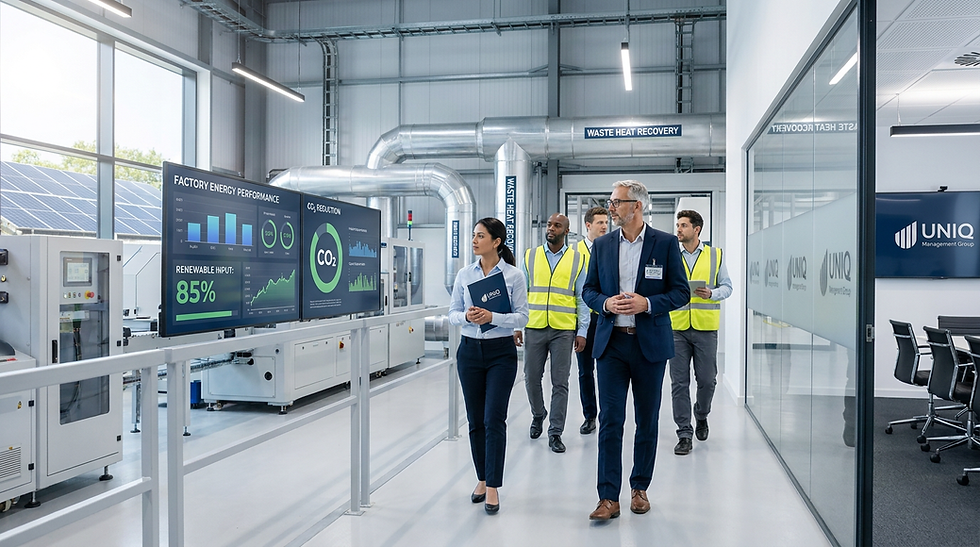
Effective industrial carbon reduction strategies prioritize high-ROI interventions first. Implementing waste heat recovery systems can capture thermal energy that would otherwise be vented into the atmosphere, redirecting it to pre-heat boiler feedwater or heat facility spaces. Upgrading to variable frequency drives (VFDs) and optimizing HVAC systems can yield double-digit percentage drops in energy consumption. These interventions require moderate capex but offer rapid payback periods, proving that environmental and financial goals can be perfectly aligned.
3. Sustainable Manufacturing Requires Technology, Discipline, and Data
Moving beyond baseline efficiency, sustainable manufacturing demands structural technological shifts. One of the most potent levers is process electrification. By transitioning from fossil-fuel-fired boilers and furnaces to industrial heat pumps and electric induction heating—powered by a increasingly renewable grid—facilities can drastically slash their Scope 1 direct emissions.
However, decarbonizing manufacturing operations requires more than just swapping out equipment. It requires measurement discipline and operational data. Facility managers cannot reduce what they do not measure. Installing sub-metering infrastructure and deploying IoT-enabled energy management systems allows operators to identify carbon-intensive bottlenecks in real-time. By utilizing predictive maintenance, plants can also ensure that machinery runs at peak efficiency, minimizing energy spikes associated with equipment degradation.

4. The ESG Benefits of Decarbonization Extend Beyond Compliance
The financial ecosystem has made its stance clear: capital is flowing toward sustainable assets. Private equity firms, commercial lenders, and institutional investors are increasingly embedding climate risk into their valuation models. The ESG benefits of decarbonization are translating directly into preferential financing rates, access to green bonds, and higher acquisition multiples.
A documented, verifiable trajectory toward net zero demonstrates strong management governance and future-proofs the asset against transition risks. Furthermore, B2B customers—from automotive OEMs to global consumer brands—are under intense pressure to reduce their Scope 3 supply chain emissions. Industrial suppliers who can provide low-carbon components will win preferential contracts, transforming their decarbonization efforts into a measurable competitive moat.
"Industrial decarbonization is no longer a peripheral sustainability initiative. It is a core operational strategy that drives asset performance, unlocks premium financing, and secures long-term market dominance."

5. What a Practical Industrial Decarbonization Roadmap Should Prioritize
Translating ambition into action requires a structured, phased approach. A credible and bankable industrial decarbonization roadmap should assess and prioritize the following dimensions:
Baseline Measurement & Data Analytics: Establish a rigorous, auditable baseline of Scope 1, 2, and 3 emissions. Implement sub-metering to track energy intensity at the individual process level.
Energy Efficiency & Process Optimization: Target the "low-hanging fruit." Fix leaks, upgrade insulation, deploy smart controls, and optimize maintenance schedules to reduce energy waste with rapid ROI.
Process Electrification & Heat Recovery: Assess the technical and economic feasibility of replacing fossil-fuel combustion with electric alternatives and capturing waste heat for secondary processes.
Renewable Energy Integration: Evaluate on-site generation (such as rooftop solar) alongside Power Purchase Agreements (PPAs) to guarantee a stable, low-carbon electricity supply.
Supply Chain Redesign (Scope 3): Collaborate with upstream suppliers to source lower-carbon raw materials, optimize logistics routing, and promote circular economy principles like material recycling.

6. Conclusion
The transition toward a low-carbon economy is the most significant industrial shift of our generation. Viewing this transition merely as a compliance exercise leaves companies vulnerable to shrinking margins and obsolete infrastructure. By embracing industrial decarbonization as an avenue for modernization, executives can drive profound organizational improvements.
For industry leaders, investors, and lenders, the mandate is clear: those who aggressively pursue energy efficiency, electrify their operations, and clean their supply chains will not just survive the climate transition—they will define it. Sustainability, when executed with operational discipline and strategic vision, is the ultimate competitive advantage.


Comments